
If you sell or ship goods from the US to customers abroad, import duty can quietly eat into your margins or scare buyers away at checkout. Many shippers do not realize that a free trade agreement between the US and the destination country might reduce that duty to zero for qualifying goods. Others assume that anything shipped from Houston automatically qualifies, and they are surprised when customs charges the full rate anyway.
This guide explains how free trade agreements work for shippers, why the country of origin matters more than the country you ship from, how rules of origin decide whether a product qualifies, what paperwork you need to claim a lower rate, and when it is worth the effort. It is written for small businesses and individual sellers, not trade lawyers, and focuses on the practical steps that make a difference on real shipments.
What a free trade agreement does
A free trade agreement (FTA) is a treaty between two or more countries that reduces or removes tariffs on goods that originate in the member countries. Instead of paying the destination country’s standard duty rate, a qualifying product can enter at a lower preferential rate, often zero.
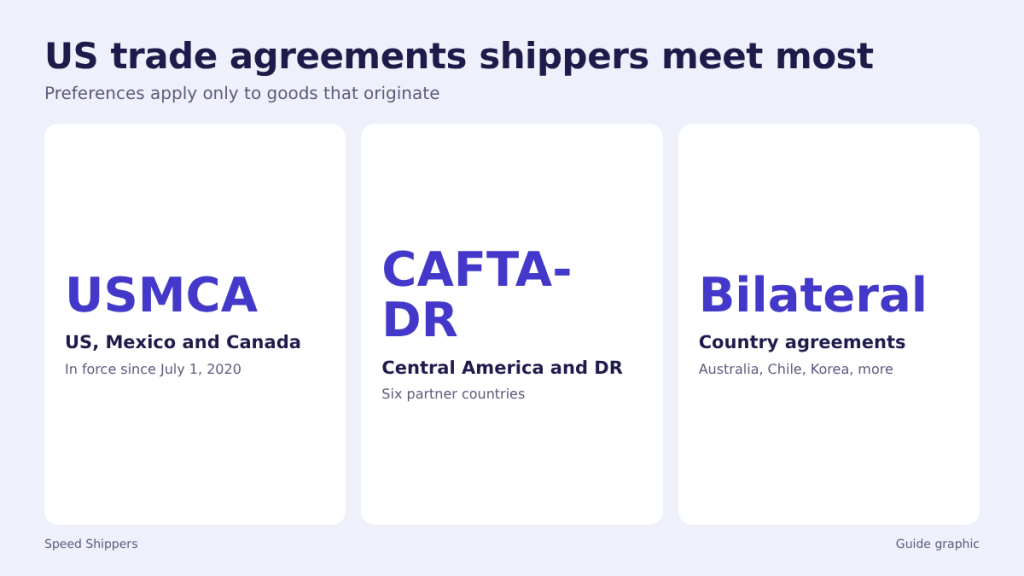
The United States has FTAs with a number of countries. Some of the most relevant for shippers in Texas include:
- USMCA: the United States-Mexico-Canada Agreement, which replaced NAFTA and entered into force on July 1, 2020.
- CAFTA-DR: covering Costa Rica, the Dominican Republic, El Salvador, Guatemala, Honduras and Nicaragua.
- Bilateral agreements with countries including Australia, Chile, Colombia, Korea, Peru, Singapore and others.
The full and current list is published by the Office of the United States Trade Representative and the International Trade Administration. Agreements are reviewed and updated, so check the official sources for the latest status.
Country of origin vs country of export
This is the single most important concept. A free trade agreement benefits goods that originate in a member country, not goods that are simply shipped from one.
Suppose you buy phone cases made in China and resell them from a Houston warehouse to customers in Mexico. The cases were shipped from the US, but their country of origin is China. They generally do not qualify for USMCA preferential treatment, and Mexico applies the regular duty rate for Chinese-origin goods.
Now suppose you make leather wallets in Texas from hides tanned in the US. Those wallets may qualify as US-origin goods under USMCA, and could enter Mexico or Canada at a preferential rate if the rules for that product are met and the claim is made correctly.
Rules of origin: how a product qualifies
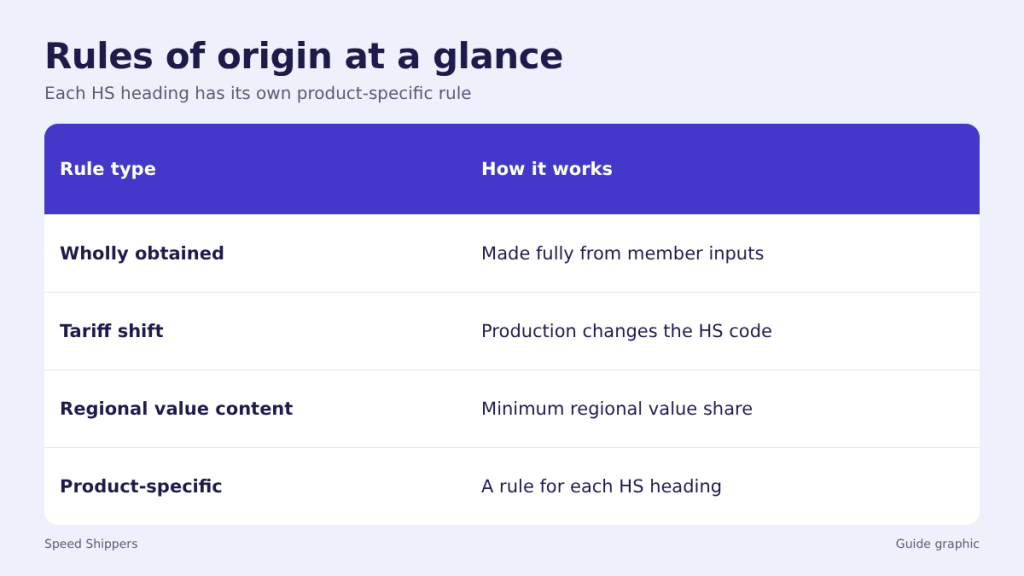
Each agreement includes detailed rules of origin that decide whether a product counts as originating. They vary by agreement and by product, but most fall into a few types:
Wholly obtained or produced
Goods grown, mined, harvested or made entirely in member countries from member-country materials. Examples include crops grown in Texas or minerals extracted in the US.
Tariff shift
Goods made from non-member materials can still qualify if production in a member country changes the product’s HS classification in a way the agreement specifies. For example, fabric from outside the region may need to be cut and sewn into a garment within the region, and some textile rules require even the yarn or fabric to be regional.
Regional value content
Some rules require a minimum share of the product’s value to come from member countries. The method and percentage depend on the agreement and the product. This test is common for automotive goods and machinery.
Product-specific rules
The agreement lists a rule for each HS heading or subheading. That is why the HS code is the starting point: you need it to find which origin rule applies.
A step-by-step process for claiming a lower rate
- Classify the product. Find the correct HS code for the item.
- Check the destination’s preferential rate. If the standard rate is already zero, there may be nothing to gain.
- Find the rule of origin for that HS code under the relevant agreement.
- Gather evidence. Bills of materials, supplier statements and production records that show the product meets the rule.
- Prepare the certification of origin in the format the agreement requires.
- Share it with the importer or carrier. The importer usually makes the claim at entry, so the paperwork must reach them or their customs broker.
- Keep records. Agreements generally require you to keep supporting documents for several years in case of a verification.
The process in practice
Take the Texas leather wallet maker from earlier, shipping a box of wallets to a retailer in Canada. The seller looks up the HS code for leather wallets, checks Canada’s tariff for the standard and USMCA rates on that code, and then reads the USMCA rule of origin for that heading. Because the hides were tanned in the US and the wallets were cut and stitched in Texas, the seller collects supplier invoices for the leather and notes where the thread and snaps came from. The seller then adds a certification of origin to the commercial invoice, emails a copy to the Canadian retailer, and files the supporting records in a folder labeled with the shipment date. If Canadian customs ever asks for verification, everything is in one place.
Certification under USMCA
USMCA does not require a specific government form. A certification of origin can be completed by the exporter, producer or importer, as long as it contains the minimum data elements set out in the agreement. It can appear on an invoice or a separate document. Other agreements have their own requirements, so check each one before shipping.
When is it worth the effort?
Claiming preferential treatment takes time and documentation. Whether it makes sense depends on a few factors:
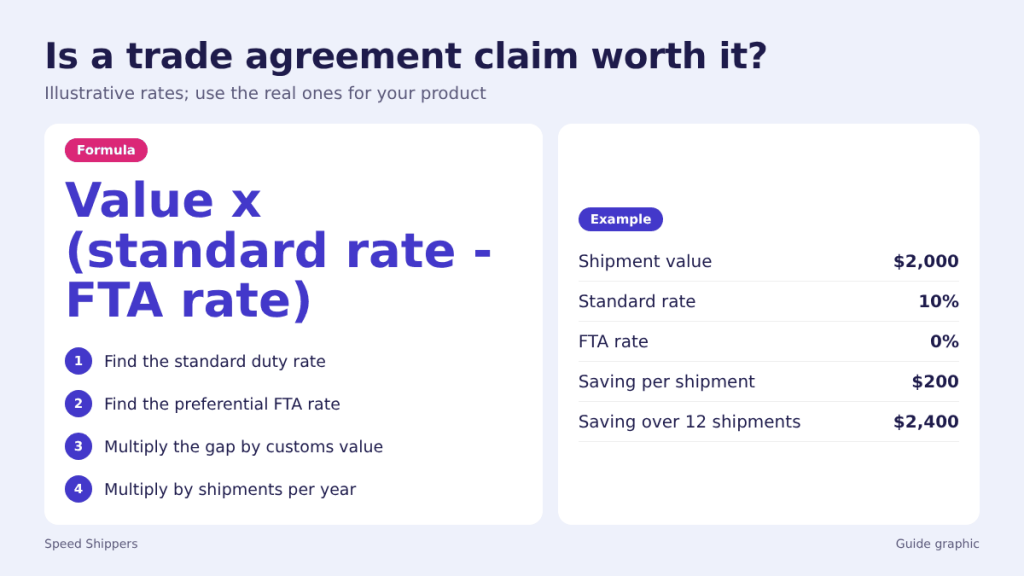
- The duty saving: the gap between the standard rate and the preferential rate, multiplied by the customs value. A 0% standard rate means no savings at all.
- Volume: a one-time personal shipment rarely justifies the paperwork, while regular commercial shipments to the same market often do.
- De minimis rules: if the destination already lets low-value shipments in duty free, an FTA claim may add nothing for small parcels.
- Your control over sourcing: if you can document where materials come from, qualifying becomes much easier.
Here is a quick way to judge the potential saving. If a product has a standard duty of 10% in the destination and qualifies for 0% under an agreement, a $2,000 shipment would save $2,000 x 0.10 = $200 in duty. Across 12 similar shipments a year, that is $200 x 12 = $2,400. Those numbers are illustrative only; use the real rates for your product.
Common mistakes to avoid
- Assuming “shipped from the US” means “US origin.” Origin follows where and how the product was made.
- Labeling imported goods as US-made. False origin claims can lead to penalties for the importer and the exporter.
- Skipping the certification. Without it, customs applies the standard rate even if the goods qualify.
- Using the wrong HS code, which can point to the wrong origin rule.
- Not telling the carrier. Courier clearance is fast and automated, so a preference claim may be missed unless the paperwork is clearly provided with the shipment.
- Throwing away records that prove origin if customs later asks for verification.
Frequently asked questions
Do free trade agreements apply to personal gifts?
In principle the same origin rules apply, but personal gifts are often covered by gift allowances or de minimis thresholds instead. FTA claims are mainly useful for commercial shipments.
Does “Made in USA” on a label prove origin?
No. Origin under a trade agreement depends on the agreement’s rules of origin for that product, supported by records. A label alone is not proof.
Who claims the preferential rate?
Usually the importer in the destination country, at the time of customs entry, using the certification and information the exporter provides.
Where can I find the rules of origin?
The text of each US agreement, including product-specific rules, is available from the Office of the United States Trade Representative, and the International Trade Administration offers guides for exporters.
Shipping commercial goods to Mexico, Canada or beyond?
Clear paperwork travels with the package. The Postal Spot offers FedEx international shipping in Houston, with help preparing commercial invoices so your origin details reach customs.