
The text looks official: your package is held at customs, and you need to pay a small fee within 24 hours or it will be returned. There is a link, a tracking-style number and sometimes a carrier logo. Because you really are waiting on an international package, it feels believable. This is one of the most common delivery scams, and it works precisely because so many people have something in transit at any given moment.
This guide explains how fake customs fee messages work, the warning signs that separate them from real notices, how genuine duty and tax requests are actually delivered, and exactly what to do if you have already clicked the link or paid. Whether you are the sender or the recipient of an international package, these checks take only a minute and can save you from stolen card details and identity theft.
How customs fee scams work
The scam follows a simple pattern. A message arrives by text, email or social media claiming to be from a postal service, a courier or a customs office. It says a package cannot be delivered because of an unpaid fee, an incomplete address or a customs hold. A link takes you to a page that looks like a real carrier website, where you are asked to enter your card details, often for a small amount.
The small amount is the hook. Few people hesitate over a minor fee, but the real goal is your card number, security code, billing address and sometimes login credentials or personal identification numbers. Those details are then used for larger fraudulent charges or sold.
Text message versions are often called “smishing,” and the US Postal Service has repeatedly warned customers about fake delivery texts. USPS states that it does not send unsolicited texts or emails with links unless a customer has signed up for tracking updates.
Warning signs of a fake customs message
Look for these red flags before you click anything:
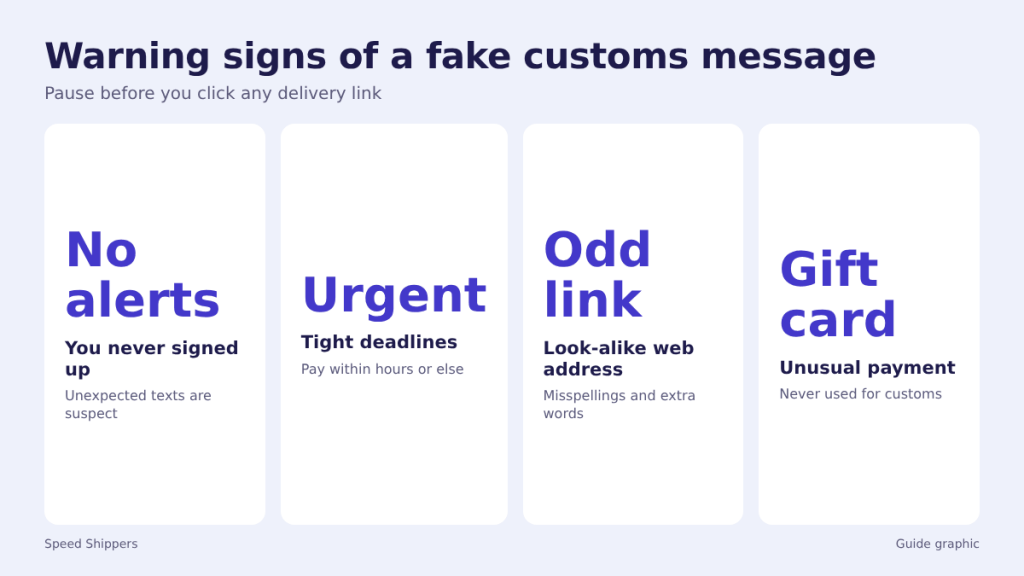
- You did not sign up for alerts. If you never requested text updates for a tracking number, an unexpected text is suspicious.
- Urgent deadlines. Phrases like “pay within 12 hours” or “final notice” are designed to make you act without thinking.
- Odd links. Real carriers use their own domains. Scam links often use misspellings, extra words, random characters or unusual endings.
- No real tracking number. The message may include a number that does not work on the carrier’s official site, or none at all.
- Generic greetings. “Dear customer” instead of your name.
- Payment for redelivery. Carriers generally do not charge a fee by text link to redeliver a package.
- Requests for unusual payment. Gift cards, cryptocurrency or wire transfers are never a legitimate way to pay customs.
- Spelling and grammar mistakes, although many scam messages now look polished, so do not rely on this alone.
How real duty and tax requests arrive
Real import charges do exist, which is why the scam works. Knowing how the genuine process looks makes fakes much easier to spot.
Courier shipments
When a FedEx or UPS international shipment owes duties and taxes, the recipient may be billed at delivery, receive an invoice afterward, or be asked to pay online before delivery. Legitimate requests are tied to a real tracking number that you can look up yourself on the carrier’s official website or app. The amount shown there should match what you are being asked to pay.
Postal shipments
For international mail, import charges are usually collected by the destination country’s postal service or customs office, not by the sender’s postal service. The recipient may pay at delivery, at the local post office or through the local postal service’s official website.
The golden rule
Never pay through a link in an unexpected message. Instead, open your browser, type the carrier’s official address yourself or use its official app, and enter the tracking number from your receipt. If a payment is really due, it will appear there.
A 60-second verification routine
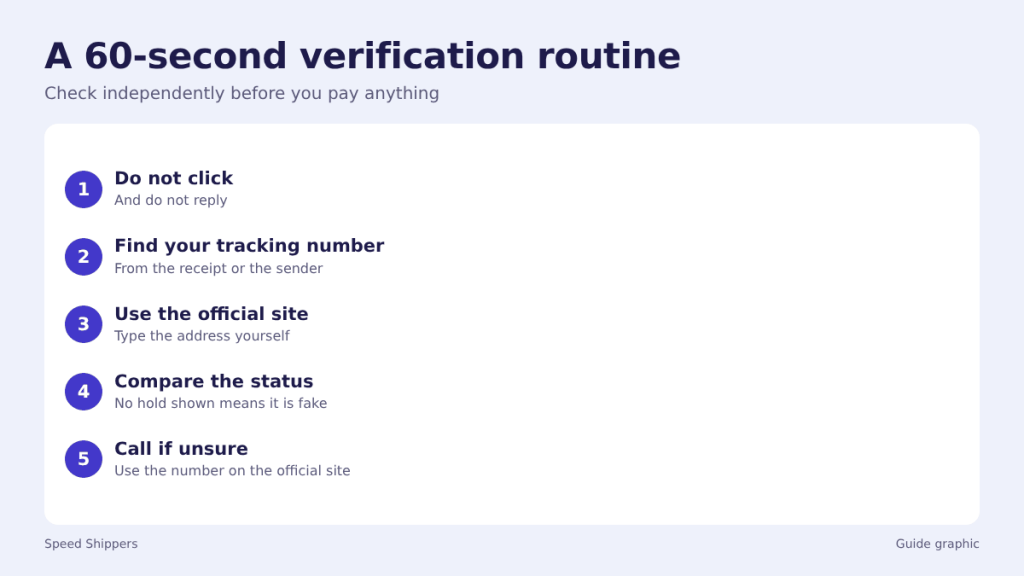
- Do not click the link and do not reply to the message.
- Find your own tracking number from your receipt, order confirmation or the sender.
- Look it up on the official carrier site by typing the address yourself.
- Compare the status. If the official tracking shows no hold or charge, the message is fake.
- If unsure, call the carrier using a phone number from its official website, not from the message.
Senders can help too. When you ship a gift abroad, tell your recipient which carrier you used and share the real tracking number. Explain whether duties are likely and how they would normally be collected. A recipient who knows what to expect is much harder to fool.
What to do if you clicked or paid
Act quickly. The sooner you respond, the less damage a scammer can do.
If you entered card details
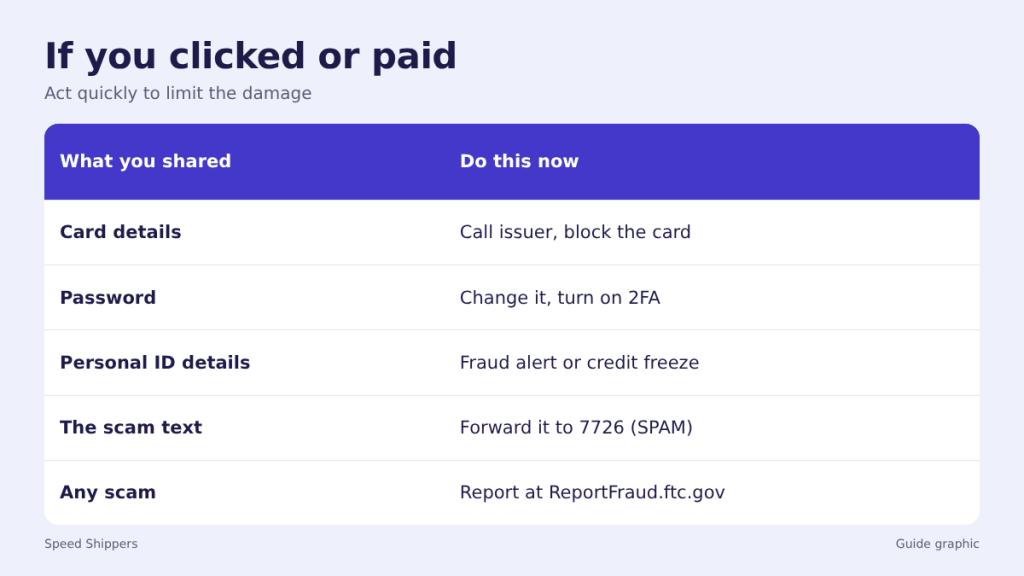
- Call your bank or card issuer immediately using the number on the back of your card.
- Ask them to block the card and issue a new one.
- Review recent transactions and dispute any you do not recognize.
If you entered a password
- Change that password right away, and on any other account where you used the same one.
- Turn on two-factor authentication where available.
If you shared personal identification details
- Consider placing a fraud alert or credit freeze with the credit bureaus.
- Watch your credit reports and accounts closely for new activity.
Report it
- Forward scam texts to 7726 (SPAM), which works with most US mobile carriers.
- Report postal-themed scams to the U.S. Postal Inspection Service.
- File a report with the Federal Trade Commission at ReportFraud.ftc.gov.
- Report courier-themed scams to the carrier through its official website.
Habits that make you a harder target
A few small habits reduce your risk every time you send or expect an international package:
- Keep one place for tracking numbers. A note on your phone or an email folder makes it easy to check whether a message matches a real shipment.
- Sign up for alerts only through official apps. Then you know exactly which messages to expect and from where.
- Use a credit card for online payments. Credit cards generally offer stronger fraud protections than debit cards.
- Turn on transaction alerts with your bank so you see any unexpected charge immediately.
- Talk to older relatives. Family members who receive gifts from abroad are frequent targets, so explain how real customs charges are collected.
Other delivery scams to watch for
Customs fee messages are only one version. Similar scams include:
- Missed delivery cards left at the door with a phone number that leads to a paid line or a scammer.
- Fake shipping invoices sent by email with attachments that contain malware.
- Package “reshipping” job offers that ask you to receive and forward goods bought with stolen cards.
- Overpayment schemes where a “buyer” sends too much money and asks you to refund the difference or pay a shipping agent.
The defense is the same in every case: verify independently through official channels before you pay, click or share anything.
Frequently asked questions
Does USPS text you about customs fees?
USPS says it does not send unsolicited texts or emails with links. If you did not sign up for text tracking on a specific package, treat any USPS-branded payment text as suspicious and check official tracking yourself.
Can a real customs fee be paid online?
Yes, some carriers and postal services offer online payment, but only through their official websites or apps. Reach them by typing the address yourself, never through a link in an unexpected message.
How do I know if my package really owes duty?
Look up the tracking number on the official carrier website. A genuine duty request will appear there or arrive as an invoice tied to that tracking number.
I paid a small amount. Is that a big deal?
Yes. The small fee is a way to capture your card details. Contact your card issuer right away to block the card, even if the charge itself was small.
Want a real receipt and tracking number?
Ship through a counter you trust and keep the paperwork. The Postal Spot is a USPS approved shipper in Houston, so you leave with an official receipt and tracking number you can verify yourself.