
You ship a $400 package overseas and your recipient is asked to pay a customs bill that seems far too high for the duty rate you looked up. Or a customer abroad complains that the import charges were more than the shipping cost. In most cases nothing went wrong. The duty was simply calculated on a different number than you expected, and an import tax was stacked on top of it.
This guide explains how import duty is calculated, step by step. You will learn what customs value means, the difference between FOB and CIF valuation, how the HS code sets the duty rate, how VAT or GST is layered on top, and how to estimate the total with a worked example. With that knowledge, you can set expectations for recipients and avoid the surprises that lead to refused packages.
The three inputs customs uses
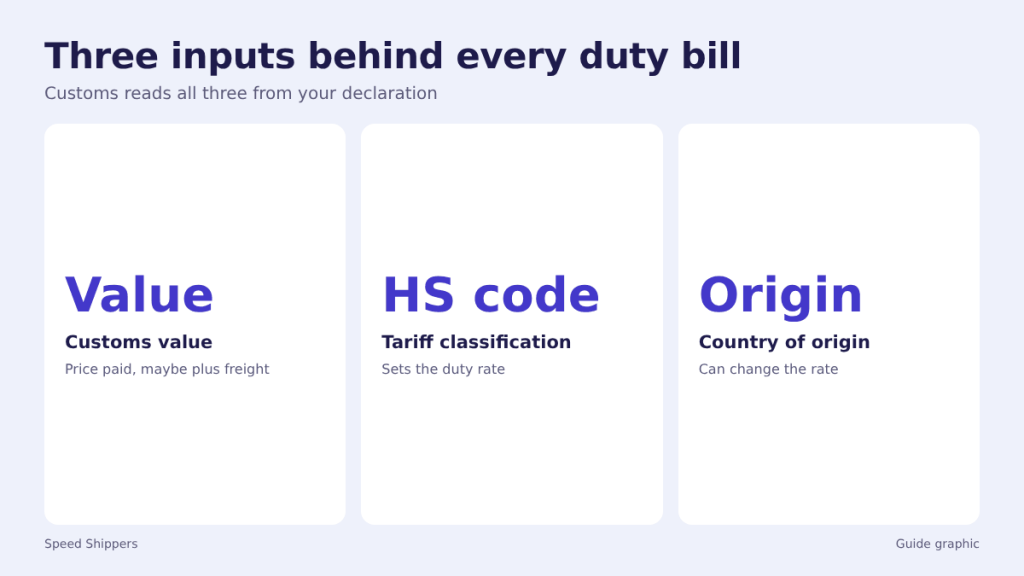
Almost every country’s import charges come from three pieces of information on your customs declaration:
- Customs value: the value of the goods for duty purposes, usually based on the price paid, and in many countries including shipping and insurance.
- Tariff classification: the HS code that identifies what the item is. Each code has a duty rate in the destination country’s tariff schedule.
- Country of origin: where the goods were made. Origin can change the duty rate, especially when a trade agreement applies.
Multiply the customs value by the duty rate and you have the duty. Add any import taxes, and you have the total the recipient will be asked to pay, plus any carrier processing fee.
What customs value really means
Customs value usually starts with the transaction value: the price actually paid or payable for the goods. For a purchase, that is the invoice price. For a gift or a used item where no sale took place, customs looks for a reasonable value, such as what similar items sell for.
The key question is what else gets added to that price. That is where FOB and CIF come in.
FOB valuation
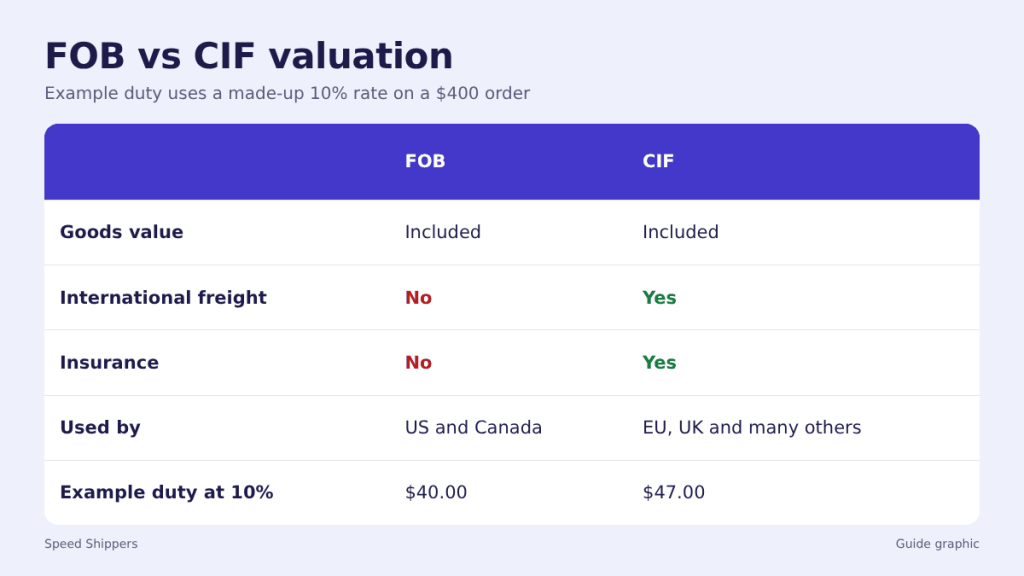
FOB stands for “free on board.” Under an FOB basis, the customs value is the value of the goods at the point of export, without international shipping and insurance. The United States and Canada generally value imports this way, so international freight is not included in the dutiable value.
CIF valuation
CIF stands for “cost, insurance and freight.” Under a CIF basis, customs adds the cost of international shipping and insurance to the value of the goods before applying the duty rate. The European Union, the UK and many countries in Asia, Africa and Latin America use CIF or a similar method. That means a higher shipping charge directly increases the duty and taxes your recipient pays.
The valuation method is set by the destination country, not by you or the carrier. Check the destination’s customs authority if you need certainty for a specific shipment.
How the HS code sets the duty rate
The Harmonized System is a global classification for goods. The first six digits are shared internationally, and each country adds further digits for its own tariff schedule. USPS requires at least a 6-digit HS code for each item on international shipments, and FedEx and UPS request them for commercial goods.
Different codes can carry very different duty rates. Cotton shirts, leather bags, electronics and food products are classified separately and often taxed at different rates. Choosing the most accurate code matters because:
- A wrong code can lead to the wrong duty rate, either higher or lower.
- Customs may reclassify the item, delaying the package.
- Repeated misclassification on commercial shipments can lead to penalties.
Look up the code using the USPS or US Census Bureau classification tools, and then check the destination country’s tariff schedule for the rate that applies to that code.
Import taxes: VAT, GST and sales tax
Duty is only part of the bill. Many countries also charge a consumption tax on imports, known as VAT, GST or a similar name. In many systems this tax is calculated on the customs value plus the duty. In other words, the tax is charged on the duty too.
Some countries also add excise taxes on specific products such as alcohol, tobacco or fuel, and some charge small administrative fees. On top of government charges, the carrier may add a fee for processing customs clearance or advancing payment on the recipient’s behalf.
A worked example with simple numbers
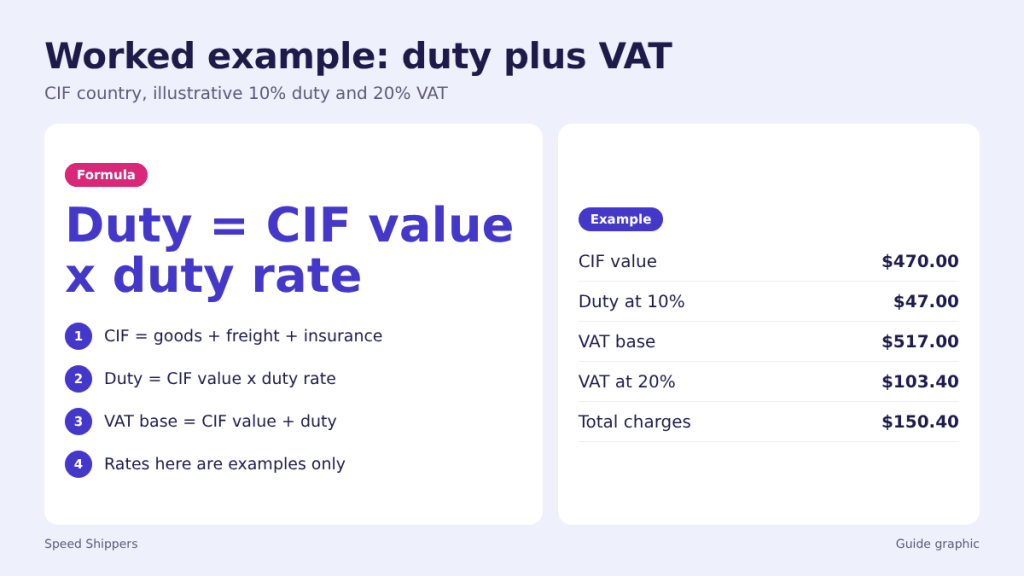
Here is how the calculation might look for a $400 order shipped to a country that uses CIF valuation. The rates below are made up for the example only. Real rates depend on the destination and the HS code.
- Value of goods: $400.00
- International shipping: $60.00
- Insurance: $10.00
- CIF customs value: $400 + $60 + $10 = $470.00
- Duty at an example rate of 10%: $470 x 0.10 = $47.00
- Tax base for VAT: $470 + $47 = $517.00
- VAT at an example rate of 20%: $517 x 0.20 = $103.40
- Total government charges: $47.00 + $103.40 = $150.40
Now compare the same shipment in a country that uses FOB valuation with the same example duty rate. The duty would be $400 x 0.10 = $40.00, because shipping and insurance are not included. That $7 difference grows quickly on larger or heavier shipments where freight costs are high.
Percentage duties vs specific duties
Most duties are ad valorem, meaning a percentage of the customs value, as in the example above. Some products instead carry a specific duty, charged per unit, per kilogram or per liter, regardless of value. Others use a combination of both. Alcohol, tobacco, some foods and certain textiles are common examples. If your item falls into one of these categories, the value you declare matters less than the quantity or weight, so check the tariff schedule carefully.
Duty-free thresholds and exemptions
Many countries set a de minimis value below which low-value imports enter without duty, tax or both. These thresholds vary widely and have changed in several countries in recent years, often downward. Some countries also offer personal gift allowances, returning-resident exemptions, or reduced rates for goods that qualify under a trade agreement.
Because these rules change, always confirm the current threshold on the destination country’s official customs website rather than relying on older articles or forum posts.
How to estimate import charges before you ship
- Find the HS code for each item using an official lookup tool.
- Check the destination tariff for the duty rate on that code and origin.
- Confirm the valuation method (FOB or CIF) and whether a de minimis threshold applies.
- Calculate duty on the correct customs value.
- Add import tax on the value plus duty, if that is how the country applies it.
- Allow for carrier fees for clearance or duty advancement.
Many carriers and customs authorities offer online duty and tax estimators. Use them as a guide, and remember the final amount is set by customs at the border.
Ways to reduce or manage import charges legally
- Describe items precisely so they are classified correctly the first time.
- Use the right origin and check whether a trade agreement reduces the rate.
- Choose who pays. Courier services let the sender pay duties upfront so the recipient is not surprised.
- Keep shipping costs reasonable for CIF countries, since freight is part of the dutiable value.
- Never undervalue goods. It can lead to fines, delays, seizure and limited insurance coverage.
Frequently asked questions
Is duty charged on the shipping cost?
It depends on the destination. Countries that use CIF valuation include international shipping and insurance in the customs value, so duty is charged on them. FOB countries, including the US and Canada, generally do not.
Why is VAT higher than the duty?
Import VAT or GST rates are often higher than duty rates, and in many countries the tax is calculated on the value plus the duty. The tax can easily exceed the duty itself.
Can I find the exact duty rate before shipping?
You can usually find the published rate for an HS code in the destination’s tariff schedule. The final amount is still decided by customs when the package arrives.
Do gifts have a different duty calculation?
Some countries offer a gift allowance, but gifts above that value are generally taxed using the same method as other imports. Declare the real value either way.
Need help with customs paperwork?
Accurate values and HS codes keep duties predictable. The Postal Spot’s international shipping counter in Houston can help you prepare customs details and compare FedEx, UPS and USPS options.