
Tracking has not moved in two weeks, or the box finally arrived with a crushed corner and a broken item inside. Either way, you want your money back, and international claims feel harder than domestic ones because two countries, two postal or courier networks and sometimes a customs agency are involved. Many people give up before they start, which is exactly what makes claims seem hopeless.
The truth is that most international claims succeed or fail on preparation and timing. This guide walks you through when to file, who should file, what evidence you need, how the process differs between USPS and private couriers, and what you can do before shipping to make any future claim much easier to win.
First, confirm the package is really lost
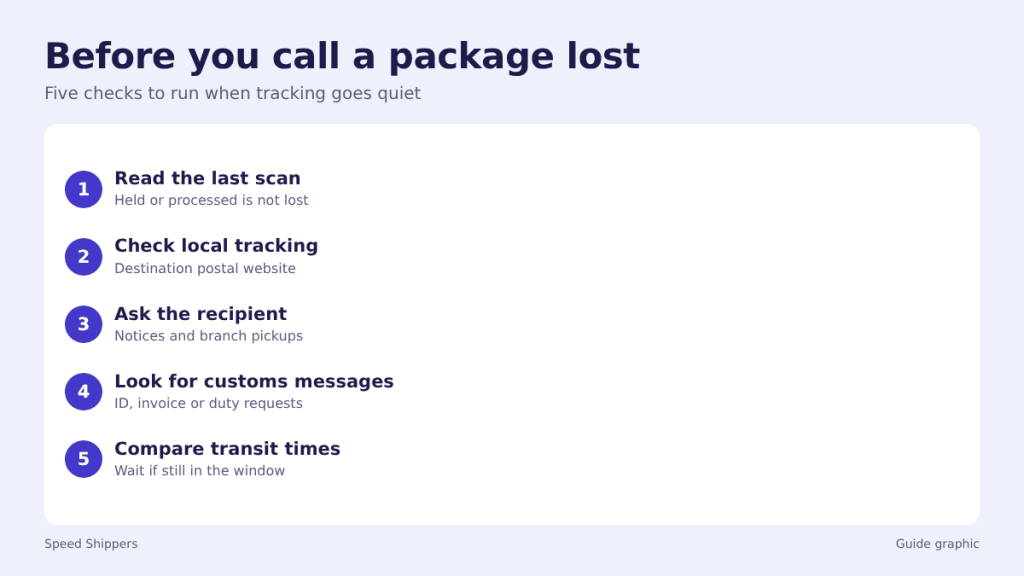
International tracking often goes quiet for days. A package can leave the US, sit in a customs queue, then be handed to a local postal operator that scans it only at delivery. Before you declare it lost, work through these checks:
- Read the last scan carefully. “Held in customs,” “awaiting information” or “processed through facility” are not lost statuses. They usually mean the package is waiting on something.
- Check the destination postal service’s tracking. USPS international tracking numbers often continue on the local post office website with more detail.
- Ask the recipient to check locally. Many countries leave a notice and hold packages at a branch, sometimes without a tracking update.
- Look for customs messages. The recipient may have received a text or email asking for an ID number, invoice or duty payment.
- Compare against normal transit times. If you are still within the carrier’s expected window for that service, wait a little longer.
If the package has passed its expected delivery window with no explanation, it is time to open an inquiry.
Inquiry vs claim: two different steps
Carriers usually separate a trace or inquiry (asking them to find the package) from a claim (asking for compensation). For international mail, the first step is often a search request. Only after the carrier, and sometimes the destination postal operator, confirms it cannot locate the item do you move to a claim for payment.
For damaged packages, you can usually go straight to a damage claim, but you must keep the item and the packaging so it can be inspected if requested.
Who should file the claim?
This catches many people out. Depending on the carrier and the service, either the sender or the recipient may be the right party to file, and the rules can differ for lost and damaged items. With most US carriers, the sender who paid for the shipment is the natural starting point because they hold the receipt, label and declared value details. For some international postal services, the recipient may need to start the process in the destination country, particularly for damage discovered at delivery.
Before filing, check the carrier’s claims page for your service, and agree with the recipient who will lead. Having both of you gather evidence at the same time saves days.
The evidence you need
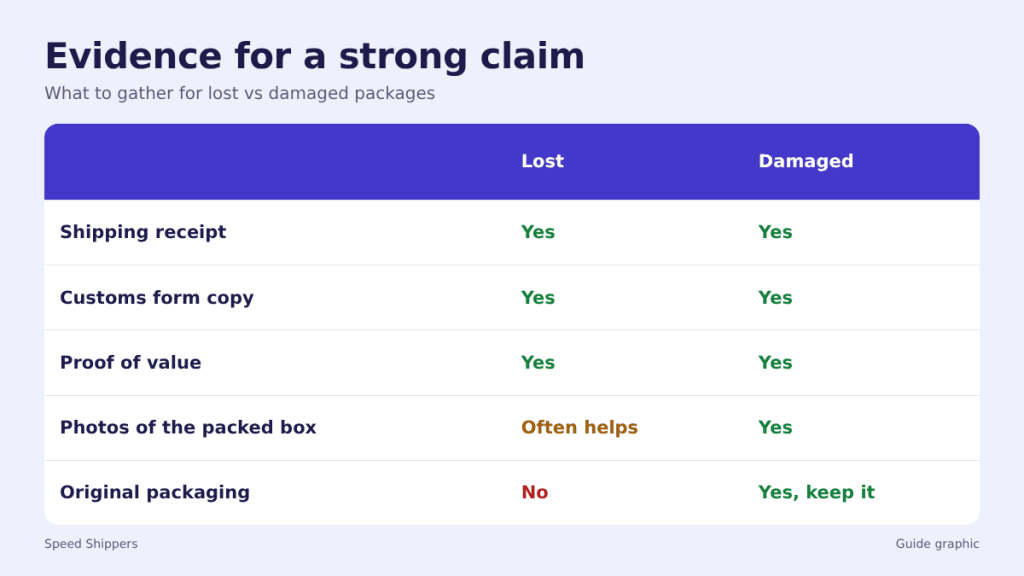
A strong claim answers three questions: what was sent, what it was worth, and what happened to it. Gather these documents before you open the claim form:
Proof of shipment
- The shipping receipt with tracking number, service type and date
- A copy of the label and customs declaration or commercial invoice
- Any confirmation emails from the carrier or shipping software
Proof of value
- Sales receipts, invoices or order confirmations for the items
- For used items or gifts, evidence of fair market value such as listings for similar items
- The declared value on the customs form, which should match your proof
Proof of damage (for damage claims)
- Photos of the outer box from several angles, including the label
- Photos of the inner packing and cushioning as it was found
- Close-up photos of the damage to each item
- Any note the recipient made on the delivery record at the door
Ask the recipient to photograph everything before unpacking fully. Once the box has been thrown away, a damage claim becomes much harder to prove.
Filing with USPS vs FedEx or UPS
USPS international claims
USPS handles international inquiries and claims online through its website. You will need the tracking number, mailing date and receipt details. Because the final leg is carried by another country’s postal operator, USPS often has to coordinate with that operator before reaching a decision, which can make international claims slower than domestic ones. Coverage depends on the service: some international services include a level of insurance, while others offer limited or no indemnity, and extra coverage may be available only for certain services and countries.
FedEx and UPS claims
Private couriers let you start a claim online with the tracking number. Their liability is generally limited to a default amount unless you declared a higher value and paid for that coverage when shipping. Because they control the package from pickup to delivery in most countries, they can often investigate faster and provide clearer scan histories.
Time limits matter
Every carrier sets a window for reporting loss or damage, and those windows can be short. They also differ between lost and damaged items and between services. Check the current deadlines on the carrier’s claims page as soon as you suspect a problem, and file well before the cutoff. A late claim is usually denied regardless of how strong the evidence is.
Why international claims get denied
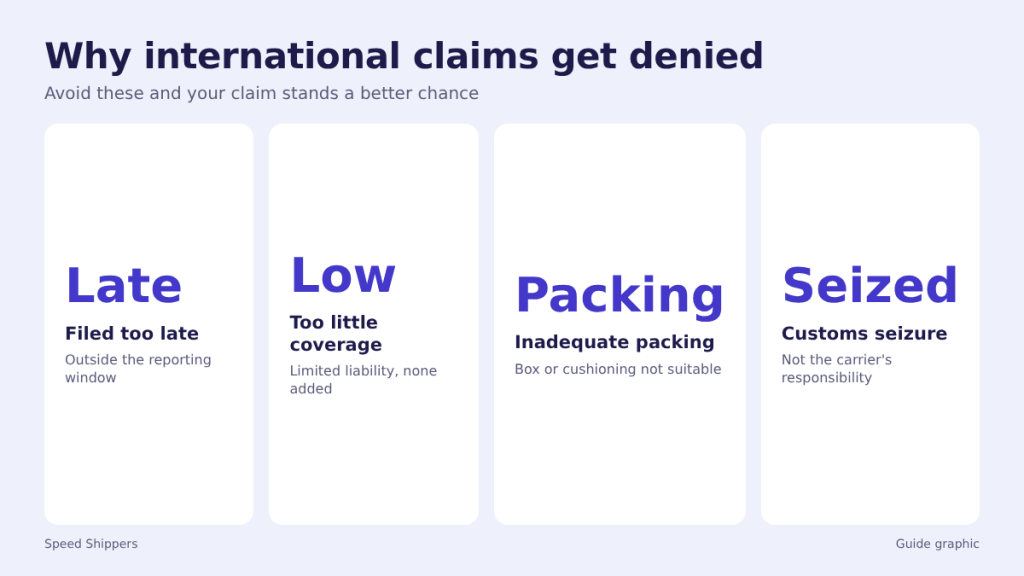
Knowing the common reasons for rejection helps you avoid them:
- Filed too late: outside the carrier’s reporting window.
- Not enough coverage: the service had limited liability and no extra coverage was purchased.
- Inadequate packing: the carrier judges that the box or cushioning was not suitable for the contents.
- Prohibited or restricted items: goods that should not have been shipped are generally not covered.
- Undervalued declarations: if you declared a low value on the customs form, that number may cap your payout.
- Missing evidence: no receipts, no photos, or the packaging was discarded.
- Customs seizure: items held or destroyed by customs authorities are usually not the carrier’s responsibility.
A simple claim timeline to follow
- Day 1 of the problem: screenshot the tracking history and ask the recipient to check locally.
- Within a few days: open an inquiry or search request with the carrier.
- Same week: collect receipts, the customs form and photos into one folder.
- Once the carrier confirms it is lost, or immediately for damage: file the claim with every document attached.
- Every week afterward: check the claim status and reply quickly to any request for information.
How to make future claims easier
The best time to prepare a claim is before you ship. A few habits make a big difference:
- Photograph items and the packed box before sealing it.
- Keep receipts and the customs form for every international shipment until it is delivered.
- Declare the real value of the contents, and buy additional coverage for anything you could not afford to lose.
- Choose a service with door-to-door tracking for valuable shipments.
- Use a new, sturdy box and enough cushioning that items cannot move when shaken.
- Avoid shipping cash, jewelry or irreplaceable items unless the service explicitly covers them.
Frequently asked questions
How long does an international claim take?
It varies by carrier and destination. Claims that require cooperation from a foreign postal operator usually take longer than courier claims. Respond quickly to any request to avoid extra delays.
Can I claim if customs seized my package?
Generally not from the carrier. Customs seizures are decisions by a government agency. Contact the destination customs office, through the recipient, to learn why it was held and whether it can be released.
Will I get the shipping cost back as well?
Some carriers refund postage for lost packages in certain cases, while others pay only the item value up to the coverage limit. Check the claim terms for your service.
What if the item arrived but pieces are missing?
Treat it as a damage or missing contents claim. Photograph the package as received, including any signs of tampering, and file promptly with the list of missing items.
Shipping something valuable overseas?
Start with the right service, coverage and packing. International shipping help at The Postal Spot in Houston covers FedEx, UPS and USPS options so you can choose tracking and protection that fit the item.