
You weigh a box, type the destination into a carrier’s website, and the quote comes back far higher than you expected. Then a friend ships a similar box to the same country for noticeably less. International shipping prices can feel random, but they are not. Every carrier builds a rate from the same handful of ingredients, and once you know what they are, you can predict a quote, compare carriers fairly and cut the cost before you ever reach the counter.
This guide breaks down how international shipping rates are calculated: billable weight, dimensional weight, destination zones, service speed, surcharges and the import costs that sit outside the carrier’s price. You will also find a worked example with real arithmetic and a checklist for lowering the number on your next quote.
The basic formula behind every international quote
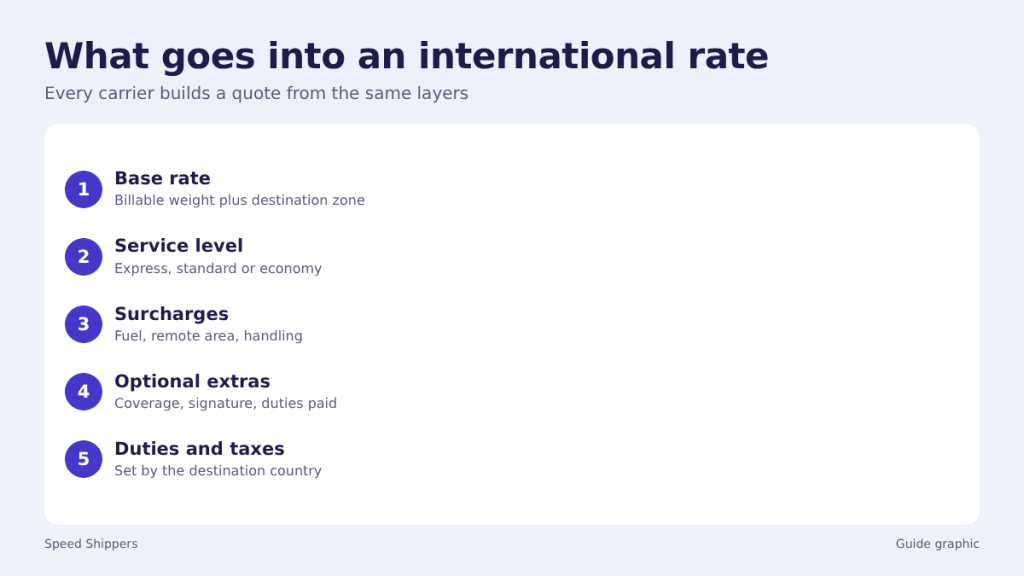
Strip away the branding and almost every international parcel rate follows the same structure:
- Base rate: set by the billable weight of the package and the destination zone or country group.
- Service level: express, standard or economy, with faster services costing more for the same box.
- Surcharges: fuel, remote delivery areas, oversize handling, residential delivery and similar add-ons.
- Optional extras: declared value coverage, signature requirements and paying the recipient’s duties upfront.
Duties and import taxes are a separate layer. They are charged by the destination government, not the carrier, although the carrier often collects them. Keeping these layers apart in your head is the first step to understanding why two quotes differ.
Billable weight: actual weight vs dimensional weight
Carriers do not simply charge for what the box weighs on a scale. They charge for the billable weight, which is the greater of two numbers: the actual weight and the dimensional (or volumetric) weight.
How dimensional weight works
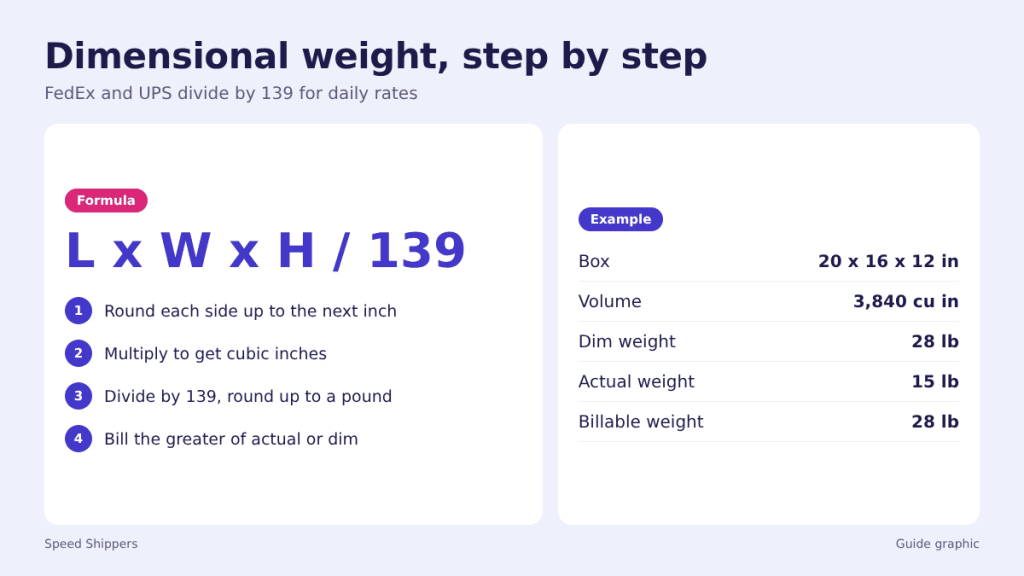
Dimensional weight reflects how much space your package takes up in a truck or aircraft. To calculate it, measure the length, width and height in inches, multiply them together, and divide by the carrier’s divisor. FedEx and UPS use a divisor of 139 for published daily rates on all package sizes. USPS also uses 139 for its domestic services that apply dimensional pricing, but international services can follow different rules, so check the specific service you are quoting.
Rounding rules
Round each measurement up to the next whole inch before multiplying, then round the resulting weight up to the next whole pound. Carriers measure at the widest points, including any bulges from overstuffed boxes.
A worked example
Say you are shipping a box of clothes that measures 20 x 16 x 12 inches and weighs 15 pounds on the scale.
- Volume: 20 x 16 x 12 = 3,840 cubic inches
- Dimensional weight: 3,840 / 139 = 27.63, which rounds up to 28 pounds
- Actual weight: 15 pounds
- Billable weight: 28 pounds, because it is the larger number
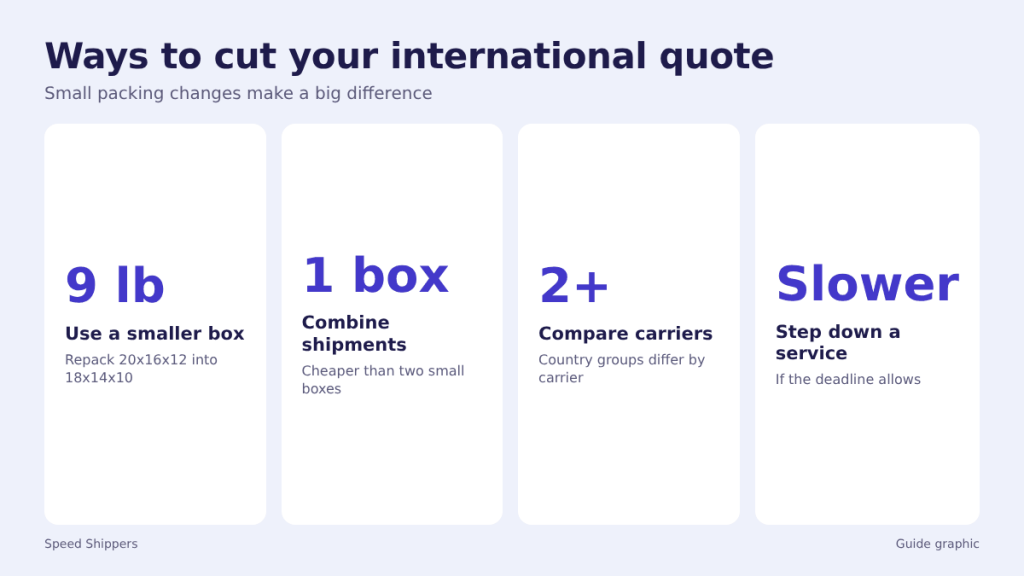
Now repack the same clothes into an 18 x 14 x 10 inch box. The volume drops to 2,520 cubic inches, and 2,520 / 139 = 18.13, which rounds up to 19 pounds. You just cut 9 pounds of billable weight without removing a single item. This is the most powerful lever you have over an international quote.
Destination zones and country groups
Domestic shipping uses distance-based zones. International shipping uses country groups instead. Each carrier sorts the world into rate groups based on its own network costs, flight frequency and local delivery partners, so a country that is cheap with one carrier may be expensive with another.
A few patterns hold across most carriers:
- Neighboring countries with heavy trade volume, such as Canada and Mexico, often sit in lower rate groups.
- Major hubs with frequent flights, like the UK, Western Europe and large Asian cities, tend to be priced more competitively than smaller markets.
- Countries where the carrier hands off to a local partner, or where delivery infrastructure is limited, usually cost more.
- Within a single country, deliveries to rural or island areas may trigger an extra remote area charge.
Because country groups differ between carriers, always quote the same box with more than one carrier before you decide.
Service level: paying for speed
The same 28-pound box can have very different prices depending on how fast you need it to arrive. Express services move on the carrier’s own aircraft with priority handling and customs pre-clearance. Economy services may wait for space, consolidate with other freight or travel part of the way by ground.
When comparing, look at the whole delivery window rather than the headline transit time. An express service that promises one to three business days may still sit in customs for a day if paperwork is incomplete, while a well-documented economy shipment can clear quickly. If the recipient does not need the package by a fixed date, stepping down one service level is often the easiest saving.
Postal vs courier pricing
Postal services like USPS hand your package to the destination country’s postal operator for final delivery. Couriers like FedEx and UPS usually control the package door to door. Postal options are often cheaper for lighter parcels, while couriers tend to become more competitive as weight and value rise, and they generally offer more detailed tracking and faster customs handling.
Surcharges that change the final price
The base rate is rarely the full story. These are the add-ons most likely to appear on an international invoice:
- Fuel surcharge: a percentage applied to the transportation charge. It changes regularly with fuel prices, so a quote from last month may not match today.
- Remote or extended area surcharge: applied when the delivery address is outside the carrier’s regular service area.
- Additional handling: for packages that are heavy, long, not fully encased in cardboard, or cylindrical.
- Oversize charges: FedEx and UPS cap packages at 150 pounds, 108 inches in length and 165 inches in length plus girth. Boxes approaching those limits often carry steep extra fees, and USPS caps parcels at 70 pounds and 130 inches in length plus girth.
- Address correction: charged when the carrier has to fix an incomplete or incorrect address.
- Duty and tax advancement: some carriers charge a fee when they pay import charges on the recipient’s behalf.
Ask for an itemized quote whenever possible so you can see which surcharges apply to your shipment.
Duties and taxes: the costs outside the carrier’s rate
Import duties and taxes such as VAT or GST are calculated by the destination country based on the declared value, the type of goods (identified by the HS code) and sometimes the shipping cost. The carrier does not set these amounts. By default the recipient pays them on delivery, but most couriers let the sender pay upfront.
When budgeting the true cost of a shipment, add three pieces together: the carrier’s transport charge, any surcharges, and the estimated import charges. A low shipping quote can be a false bargain if the recipient faces a large bill at the door. Accurate item descriptions and HS codes help customs assess the right amount the first time.
How to lower your international shipping cost
- Use the smallest box that protects the contents. As the example showed, a few inches can remove many pounds of billable weight.
- Remove empty space and bulky fillers. Compress soft items like clothing and use thin, efficient padding for fragile items.
- Combine shipments. One larger box is usually cheaper than two smaller ones going to the same address.
- Compare at least two carriers. Country groups and surcharges differ, so the cheapest carrier depends on the destination.
- Choose the slowest service that still meets your deadline.
- Get the address right. Complete addresses avoid correction fees and delays.
- Declare accurately. Correct values and HS codes prevent customs holds that can add storage or handling charges.
Frequently asked questions
Why is my quote based on a higher weight than my box?
The carrier is charging dimensional weight, which applies when a package is large for its weight. Measure the box, divide the volume by the divisor, and compare it with the scale weight. The larger number is what you pay for.
Do I pay the fuel surcharge on international shipments?
Yes. Fuel surcharges apply to international services and are usually expressed as a percentage that changes over time. Check the carrier’s current surcharge table when comparing quotes.
Is shipping cheaper with USPS or a courier?
It depends on weight, destination and how quickly you need delivery. Postal options often win for light packages, while couriers can be competitive for heavier or higher-value parcels. Quote both for the same box.
Are duties included in the shipping price?
Usually not. Duties and import taxes are set by the destination country and billed separately, normally to the recipient, unless you choose a service where the sender pays them upfront.
Want a side-by-side international quote?
Bring your box in and compare options in person: The Postal Spot is a FedEx Authorized ShipCenter in Houston that can measure, weigh and price your shipment before it leaves.